The Complete Guide to Vitamin D
Vitamin D is one of the most researched nutrients in medicine, yet deficiency remains one of the most widespread health problems in the world. Estimates suggest that over a billion people are deficient or insufficient. In the US alone, studies consistently find that roughly 40% of adults have levels below what most functional medicine practitioners consider optimal.
So why is this still such a common problem? Three reasons come up repeatedly in clinical practice.
First, most people rely on sun exposure without realizing how many factors limit how much vitamin D their skin can actually make.
Second, most doctors test vitamin D in isolation and use a reference range that defines “sufficient” far below where the research shows optimal function.
And third, vitamin D doesn’t work well alone. It depends on a set of cofactors that many people taking Vitamin Dsupplements aren’t aware of.
This Vitamin D guide covers all of it. You’ll learn how vitamin D actually works, why deficiency is so common, what the research shows about its benefits beyond bone health, how to test and interpret your results properly, and how to supplement safely and effectively.
Whether you’re trying to fix a deficiency or simply optimize your long-term health, this is the complete picture.
Key Takeaways
- Vitamin D functions like a hormone, not a simple vitamin. It binds to receptors in virtually every tissue and directly influences gene expression across your immune system, gut, brain, heart, and metabolism.
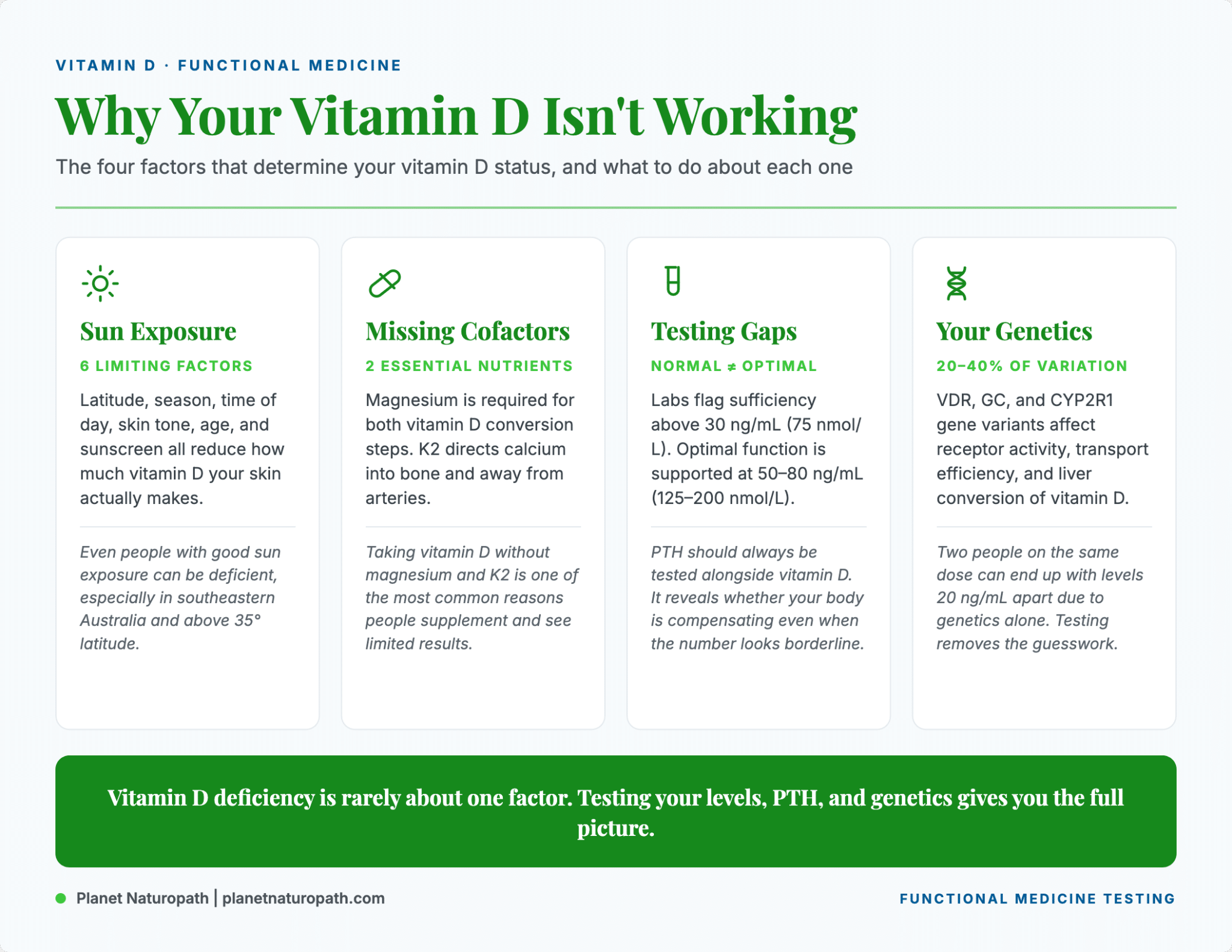
- Sun exposure alone is often not enough. Latitude, season, time of day, skin tone, age, sunscreen use, and your genetics all determine how much vitamin D your skin actually produces.
- The standard “sufficient” range is not the same as optimal. Most labs flag deficiency below 20 ng/mL and sufficiency above 30 ng/mL, but the research supports optimal function at 50 to 80 ng/mL for most people.
- Parathyroid hormone (PTH) is the missing test. PTH tells you whether your body is compensating for low vitamin D even when your serum level looks borderline normal.
- Magnesium and vitamin K2 are essential cofactors, not optional extras. Magnesium is required for vitamin D activation and receptor signaling. K2 directs calcium into bone and away from arteries.
- Your genetics influence your vitamin D at every stage, from skin synthesis through to receptor activity. This is why two people taking the same dose can end up with very different results.
What Makes Vitamin D Different From Other Vitamins
Most people understand vitamin D as the “sunshine vitamin” that keeps bones strong. Both parts of that description are true but they significantly undersell what this nutrient does.
Technically, vitamin D is classified as a fat-soluble vitamin. But functionally it behaves like a steroid hormone. Once vitamin D is converted to its fully active form, calcitriol, it binds to vitamin D receptors (VDRs) inside cells and directly influences gene transcription.
It turns genes on and off. This is the mechanism behind its remarkable benefits across different body systems.
The VDR receptor is expressed in virtually every tissue in the body, including immune cells, gut lining, brain neurons, cardiac muscle, vascular smooth muscle, and pancreatic beta cells. This is why vitamin D deficiency is associated with such a wide range of conditions.
It’s not that vitamin D is a miracle cure for everything. It’s that adequate vitamin D is part of normal cellular function across most of your body’s major systems. When it’s chronically low, you don’t just get weaker bones.
You get a quietly compromised immune system, a more permeable gut barrier, reduced neurotransmitter synthesis capacity, and increased cardiovascular risk, often without any obvious symptoms for years.
Understanding vitamin D as a hormone rather than a simple nutrient changes how you approach testing, dosing, and long-term maintenance. It also explains why having a deficiency right matters much more than most people realize for long term health.
Why Vitamin D Deficiency Is So Common
The short answer is that we’ve created a modern lifestyle that’s profoundly mismatched with the conditions our bodies need to maintain vitamin D status naturally.

Why Sun Exposure Alone Isn’t Enough for Vitamin D
UVB rays, the specific wavelength that triggers vitamin D synthesis in skin, are only present at meaningful levels when the sun is high enough in the sky.
At latitudes above 35 degrees north or south, which includes most of the US, all of Canada, and most of Europe, UVB levels become inadequate from roughly October through March regardless of how much time you spend outside. Even in summer, UVB is only sufficient between about 10am and 3pm.
For Australian clients, latitude is less of an issue in the north, but southeastern Australia, where most of the population lives, has winters where UVB levels drop more than most people expect.
More importantly, Australia has one of the highest rates of skin cancer in the world, and the public health message to cover up and avoid burning is well known.
The reality is that responsible sun protection and adequate vitamin D production are largely incompatible, which makes supplementation just as relevant for Australians as for anyone living at higher latitudes.
Skin pigmentation, age, sunscreen use, and clothing coverage compound this further. People with darker skin need significantly longer sun exposure to produce the same vitamin D as someone with lighter skin, because melanin acts as a natural UVB filter.
After age 70, the skin produces roughly 75% less vitamin D from the same sun exposure compared to younger adults. A sunscreen with SPF 30 reduces vitamin D synthesis by around 95 to 99%. And UVB doesn’t penetrate glass, meaning time near windows doesn’t count.
How Genetics Affect Your Vitamin D Levels
Even people who navigate all the environmental factors can still test low because their biology processes vitamin D differently. The GC gene determines how efficiently vitamin D is transported through the bloodstream once made.
Variants in CYP2R1 affect how efficiently the liver converts vitamin D into its measurable circulating form. And the VDR gene governs how well cells respond to vitamin D once it arrives.
For example my wife spent years as the captain of a tourist boat at the Great Barrier Reef, on the water every single day in tropical Queensland. You cannot get more sun exposure than that.
When she tested her vitamin D, it came back at 50 nmol/L in Australian units, which is approximately 20 ng/mL in US measurements. Clearly deficient, despite conditions that should have made deficiency almost impossible.
When she tested her VDR genetics, she had multiple variants stacking, including the BsmI variant associated with reduced receptor activity. Her body was producing vitamin D from all that sun. Her receptor simply wasn’t responding to it efficiently.
Just because you get good sun exposure does not mean you have optimal Vitamin D levels.
Vitamin D Benefits Beyond Bone Health
Most people associate vitamin D with calcium absorption and bone density. That’s true but represents a small fraction of what vitamin D actually does. Here are the areas with the strongest evidence.

Vitamin D and Immune Function
Vitamin D plays two complementary roles in immunity. It enhances innate immunity, your first-line defense system, by stimulating the production of antimicrobial peptides called cathelicidin and defensins that directly attack pathogens.
It also regulates adaptive immunity, the targeted immune response, which is where its relevance to autoimmune conditions comes from.
Low vitamin D is associated with increased risk of multiple sclerosis, rheumatoid arthritis, type 1 diabetes, and inflammatory bowel disease.
A meta-analysis of randomized controlled trials found that supplementation reduced the risk of acute respiratory infections, with the greatest benefit in people who were deficient at baseline.
Vitamin D and Gut Health
Vitamin D receptors are highly expressed throughout the gut lining. Vitamin D maintains the integrity of tight junction proteins, the molecular seals that keep the intestinal barrier intact. When vitamin D is deficient, tight junction function degrades, contributing to increased intestinal permeability.
There’s also a direct relationship with the gut microbiome: vitamin D shapes bacterial composition and certain gut bacteria influence vitamin D metabolism, meaning poor gut health can worsen vitamin D status and vice versa.
Vitamin D, Brain Health, and Mood
Vitamin D receptors are present in the hippocampus, prefrontal cortex, and limbic system. Vitamin D activates the gene encoding tryptophan hydroxylase 2, the enzyme that converts tryptophan to serotonin in the brain.
Low vitamin D therefore reduces serotonin synthesis capacity, which is one mechanism behind the strong association between deficiency and depression, particularly seasonal affective disorder.
Vitamin D also influences dopamine production through VDR signaling, and lower levels are associated with increased risk of cognitive decline and Alzheimer’s disease.
Vitamin D, Cardiovascular Health, and Metabolism
Vitamin D receptors in cardiac muscle and vascular cells influence blood pressure regulation partly through the renin-angiotensin system. Low vitamin D is consistently associated with hypertension, heart failure, and cardiovascular disease in observational data.
The VITAL trial, a large randomized controlled trial, found a reduction in cardiovascular mortality with supplementation.
On the metabolic side, vitamin D receptors in pancreatic beta cells influence insulin secretion and sensitivity, and deficiency is associated with increased type 2 diabetes risk.
How to Test Your Vitamin D Properly
The test you want is 25-hydroxy vitamin D, also written 25(OH)D. This is the storage form your liver produces and the most reliable marker of overall vitamin D status. It’s the form virtually all research is based on and which most doctors check.

Why Standard Vitamin D Reference Ranges Fall Short
Most labs flag deficiency below 20 ng/mL and sufficiency above 30 ng/mL. If you come back at 32 ng/mL, your result looks normal and your doctor has no reason to act.
But the research consistently shows that the benefits for immune function, mood, cardiovascular health, and disease risk reduction cluster at levels of 40 ng/mL and above. A minimum of 40 ng/mL is a reasonable clinical threshold, with an optimal range of 50 to 80 ng/mL for most people.
For Australian clients, results are reported in nmol/L — to convert, simply multiply by 2.5. So the optimal range of 50 to 80 ng/mL translates to approximately 125 to 200 nmol/L, with 100 nmol/L as a reasonable minimum.
Most Australian labs flag deficiency below 50 nmol/L and sufficiency above 75 nmol/L, which again falls well short of where the research supports optimal function.
PTH: The Missing Test for Vitamin D Status
PTH is produced by four small glands behind your thyroid. When vitamin D is low and calcium absorption drops, PTH rises to compensate by pulling calcium from bone to keep blood levels stable.
This is called secondary hyperparathyroidism, and it can happen silently even when your vitamin D level looks borderline acceptable.
The clinical value of PTH is that it adds context. A vitamin D of 45 ng/mL with a low-normal PTH likely means your body is managing well. The same level with an elevated PTH tells you the body is still compensating and your functional requirement is higher.
Conversely, someone at 35 ng/mL with a low PTH may genuinely be fine for their individual physiology. PTH turns a number into a functional assessment.
The full panel worth running alongside your vitamin D includes serum calcium (elevated calcium plus high-dose supplementation is an early toxicity signal), magnesium (below 2.0 mg/dL is worth addressing regardless of lab reference range), alkaline phosphatase (elevated ALP can indicate bone turnover from prolonged deficiency), and phosphorus.
For genetics, SelfDecode offers dedicated vitamin D and VDR gene reports that analyze your genetic variants and provide personalized recommendations. If your levels don’t respond to supplementation as expected, genetics are worth investigating. You can use existing DNA data from 23andMe or AncestryDNA. Learn more about SelfDecode here.
Essential Cofactors for Vitamin D Absorption
Vitamin D does not work in isolation. Taking it without addressing the supporting nutrients is one of the most common reasons people supplement for months and see limited results.

Magnesium: The Key Vitamin D Cofactor
Magnesium is the most important cofactor and the most commonly depleted. Both conversion steps in the vitamin D pathway, liver hydroxylation to 25(OH)D and kidney activation to calcitriol, require magnesium-dependent enzymes.
If your magnesium is low, your vitamin D conversion is sluggish regardless of how much you take. Adding to this, vitamin D processing depletes magnesium stores, so the more vitamin D you supplement, the more magnesium you need.
Low magnesium also impairs VDR receptor function, meaning even adequate levels struggle to signal properly at the cellular level.
Magnesium glycinate is the form I recommend: well absorbed, well tolerated, and unlikely to cause the digestive issues associated with magnesium oxide. A dose of 200 to 400 mg daily, taken in the evening, covers both the vitamin D cofactor requirement and offers additional benefits for sleep quality.

Vitamin K2
Vitamin K2 addresses the safety concern most people don’t know to ask about. Vitamin D increases calcium absorption from the gut, which is the point.
But more circulating calcium needs somewhere to go, and without adequate K2, it can deposit in arterial walls rather than bone.
K2 activates two key proteins: osteocalcin, which incorporates calcium into bone matrix, and matrix Gla protein, which actively inhibits calcification of soft tissue. Vitamin D opens the calcium tap. K2 makes sure the water goes where it should.
MK-7 is the preferred form, with a much longer half-life than MK-4, allowing once-daily dosing. A dose of 100 to 200 mcg daily, taken with a fat-containing meal, is appropriate for most adults.
Note: if you take warfarin or any anticoagulant, speak with your doctor before adding K2, as it can interact with how these drugs work.
Calcium and Vitamin D: What You Need to Know
Calcium supplementation is not necessary for most people if dietary intake is adequate and K2 is included. The main risk with calcium supplementation is taking it without K2, which has raised cardiovascular concerns in the research.
Vitamin D Dosing: How Much Do You Actually Need?

The official recommended dietary allowance of 600 to 800 IU per day is the amount needed to prevent severe deficiency at a population level. It is not the amount most individuals need to reach or sustain an optimal range.
For most adults who test deficient or insufficient, a dose of 2,000 to 5,000 IU of vitamin D3 daily is a good starting range.
Where you sit within that range depends on your baseline level, body weight, sun exposure, and genetics. People with significant deficiency or relevant genetic variants, particularly VDR or GC variants affecting receptor activity or transport efficiency, often need toward the higher end.
If you’re in Australia, most over-the-counter vitamin D supplements are capped at 1,000 IU per capsule by the TGA. At that dose, many people will not move their levels meaningfully, particularly in winter.
The practical workaround is liquid drops: brands like Metagenics and Orthoplex offer formulations where four to five drops delivers 4,000 to 5,000 IU, allowing therapeutic dosing within the regulatory framework.
In the US, higher-dose single capsules are widely available. Brands like Pure Encapsulations, Thorne, and Seeking Health produce quality options, though there are many good brands. The key things to check: make sure the product uses vitamin D3 (cholecalciferol) rather than D2 (ergocalciferol), as D3 is significantly more effective at raising serum levels.
Also check that the capsule contains an oil base or take it with a fat-containing meal, since vitamin D is fat-soluble and absorption drops substantially without dietary fat.
Vitamin D and Your Genetics
If you’ve been supplementing consistently and your levels aren’t responding the way you’d expect, genetics are often the explanation. Around 20 to 40% of the variation in vitamin D levels between people comes down to inherited differences in how the body handles vitamin D at each stage of the pathway.
The three most clinically relevant genes are VDR (receptor sensitivity), GC (binding protein transport efficiency), and CYP2R1 (liver conversion).
Variants in these genes can mean your body either produces less vitamin D from sun exposure, clears it from circulation faster, converts it less efficiently, or responds to it less effectively at the receptor level, often in combination.
This is what explained my wife’s situation at the Great Barrier Reef. Her sun exposure was as close to ideal as it’s possible to get.
Her VDR variants, specifically the BsmI TT genotype and FokI AG variant, meant her cells were less responsive to the vitamin D she was producing. The serum level didn’t reflect the functional deficit.
Testing your genetics through a tool like SelfDecode gives you a personalized picture of which variants you carry, how they affect your vitamin D pathway, and what interventions are most likely to work for your specific biology. SelfDecode also has a strict privacy policy and will not share your data Find out more here.
Is Vitamin D Toxicity a Real Concern?

Yes, but the threshold is much higher than most people realize, and the fear around it is causing real harm in the other direction.
Vitamin D toxicity (hypervitaminosis D) occurs when levels are high enough to cause hypercalcaemia, or elevated blood calcium. Symptoms include nausea, weakness, kidney stones, and in severe cases, cardiac arrhythmia.
These are real and serious consequences. But the doses required to produce them are far beyond normal supplementation ranges. Cases in the medical literature almost universally involve accidental very high-dose ingestion, manufacturing errors, or prolonged unsupervised megadosing well above 10,000 IU per day.
At 2,000 to 5,000 IU daily with cofactors in place, toxicity risk is extremely low. A vitamin D level of 50 to 80 ng/mL with normal serum calcium is not a toxicity concern, regardless of what a conservative lab reference range suggests.
The red flag is elevated calcium alongside high vitamin D, not the vitamin D number alone. People with granulomatous diseases like sarcoidosis, primary hyperparathyroidism, or certain lymphomas need closer monitoring, as these conditions can cause the body to overproduce active vitamin D independent of supplementation.
The opposite problem is actually more common and more clinically significant. Many people, particularly younger adults in their 20s, 30s, and 40s, have low vitamin D with no obvious symptoms. They may try supplementing for a few months, notice no dramatic change, and stop.
This is understandable but misses the point. The body compensates for low vitamin D silently through PTH elevation and bone calcium mobilization, maintaining normal blood calcium and giving no short-term signs that anything is wrong.
The cost accumulates over decades: reduced bone density, a quietly dysregulated immune system, and increased long-term risk of conditions that feel far removed from vitamin D.
Think of it as a slow financial deficit. You don’t feel it month to month. But compound it over 30 years and the consequences become significant. The measure of whether supplementation is working is not “do I feel different.” It’s whether your blood level and PTH have moved.
Your Vitamin D Action Plan
Whether you’re starting from scratch or reassessing an existing protocol, these six steps cover the essentials.
1. Test before you supplement. Get a baseline 25-hydroxy vitamin D and PTH. This tells you where you’re starting and whether your body is already compensating.
2. Check your cofactors. Add magnesium glycinate 200 to 400 mg daily and vitamin K2 as MK-7 100 to 200 mcg daily alongside your vitamin D. These are not optional.
3. Choose the right form and dose. Vitamin D3, not D2, taken with fat. A dose of 2,000 to 5,000 IU daily for most adults, toward the higher end if you’re significantly deficient or live at higher latitude.
4. Consider your genetics. If your levels don’t respond as expected after 12 weeks, or you want to understand your vitamin D biology from the start, genetic testing via SelfDecode provides clinically actionable information based on your individual variants.
5. Retest at 8 to 12 weeks. Include PTH alongside 25(OH)D. If PTH has normalized and vitamin D has risen, the protocol is working. If levels haven’t moved, review dose, cofactors, and genetic factors.
6. Maintain year-round. Once you’ve reached an optimal range, the goal shifts to sustaining it. For most people at higher latitudes, year-round supplementation is necessary, with possibly a slight dose increase through winter months.
Frequently Asked Questions
What is the optimal vitamin D level?
Most labs define sufficiency as anything above 30 ng/mL, but functional medicine practitioners generally aim for 50 to 80 ng/mL as an optimal range. A minimum of 40 ng/mL is a reasonable clinical threshold for most people. That said, the number alone doesn’t tell the whole story. PTH provides the functional context that makes the vitamin D result meaningful — someone at 45 ng/mL with a low PTH is likely fine, while the same level with an elevated PTH suggests the body is still compensating and the requirement is higher.
Can I get enough vitamin D from the sun?
For many people, no. Latitude above 35 degrees makes meaningful vitamin D synthesis essentially impossible in winter. Add in age, skin pigmentation, sunscreen use, clothing coverage, and genetic factors affecting skin synthesis and transport efficiency, and sun exposure becomes unreliable as your primary strategy. Sensible sun exposure still has genuine value for mood, circadian rhythm, and overall wellbeing. It just should not be assumed to be sufficient for vitamin D without testing to confirm.
What happens if I take vitamin D without magnesium?
Two things. First, the conversion of vitamin D to its active forms is impaired, because both liver and kidney conversion steps require magnesium-dependent enzymes. Your levels may respond less than expected to supplementation. Second, high-dose vitamin D further depletes magnesium stores, which can trigger symptoms including muscle cramps, poor sleep, anxiety, and constipation, even in people who weren’t noticeably deficient beforehand.
How long does it take to raise vitamin D levels?
At doses of 2,000 to 5,000 IU daily, most people see meaningful movement in their 25(OH)D level within 8 to 12 weeks. The rate of increase varies significantly depending on baseline deficiency, body weight, magnesium status, genetics, and whether cofactors are in place. This is why retesting at the 8 to 12 week mark is important rather than assuming a dose is working.
Should children take vitamin D?
Vitamin D deficiency is common in children, particularly in those with darker skin, those living at higher latitudes, and those with limited sun exposure. The standard pediatric recommendation is 400 IU per day for infants and 600 IU for older children, though functional medicine practitioners often use higher doses based on individual testing. Breastfed infants are at particular risk as breast milk is typically low in vitamin D. Testing is the most reliable way to know whether a child’s levels are adequate, and supplementation should be discussed with a healthcare provider familiar with vitamin D.
What is the difference between vitamin D2 and D3?
Vitamin D3 (cholecalciferol) is the form produced by the skin in response to sunlight and found in animal products. Vitamin D2 (ergocalciferol) is the plant-based form produced by fungi and yeasts. Research consistently shows that D3 is more effective at raising and maintaining serum 25(OH)D levels, with estimates suggesting D3 is roughly 87% more potent in this regard. For supplementation purposes, D3 is always the preferred form.
References
- Holick MF. Vitamin D deficiency. N Engl J Med. 2007;357(3):266-281. https://pubmed.ncbi.nlm.nih.gov/17634462/
- Forrest KY, Stuhldreher WL. Prevalence and correlates of vitamin D deficiency in US adults. Nutr Res. 2011;31(1):48-54. https://pubmed.ncbi.nlm.nih.gov/21310306/
- Martineau AR, et al. Vitamin D supplementation to prevent acute respiratory tract infections: systematic review and meta-analysis. BMJ. 2017;356:i6583. https://pubmed.ncbi.nlm.nih.gov/28202713/
- Uwitonze AM, Razzaque MS. Role of magnesium in vitamin D activation and function. J Am Osteopath Assoc. 2018;118(3):181-189. https://pubmed.ncbi.nlm.nih.gov/29480918/
- Lips P. Vitamin D physiology. Prog Biophys Mol Biol. 2006;92(1):4-8. https://pubmed.ncbi.nlm.nih.gov/16563471/
- Bikle DD. Vitamin D metabolism, mechanism of action, and clinical applications. Chem Biol. 2014;21(3):319-329. https://pubmed.ncbi.nlm.nih.gov/24529992/
- Manson JE, et al. Vitamin D supplements and prevention of cancer and cardiovascular disease. N Engl J Med. 2019;380(1):33-44. https://pubmed.ncbi.nlm.nih.gov/30415629/
- Wang TJ, et al. Common genetic determinants of vitamin D insufficiency: a genome-wide association study. Lancet. 2010;376(9736):180-188. https://pubmed.ncbi.nlm.nih.gov/20541252/
- Patrick RP, Ames BN. Vitamin D hormone regulates serotonin synthesis. FASEB J. 2014;28(6):2398-2413. https://pubmed.ncbi.nlm.nih.gov/24558199/
- Ginde AA, et al. Demographic differences and trends of vitamin D insufficiency in the US population. Arch Intern Med. 2009;169(6):626-632. https://pubmed.ncbi.nlm.nih.gov/19307527/
- Heaney RP, et al. Vitamin D3 is more potent than vitamin D2 in humans. J Clin Endocrinol Metab. 2011;96(3):E447-452. https://pubmed.ncbi.nlm.nih.gov/21177785/
- Giovannucci E, et al. 25-hydroxyvitamin D and risk of myocardial infarction in men. Arch Intern Med. 2008;168(11):1174-1180. https://pubmed.ncbi.nlm.nih.gov/18541825/